Electric Kettle OEM & ODM
An electric kettle is one of the few appliances where the safety devices are the product: a boil-dry cut-out that fails is a fire. The parts that matter are the steam sensor, the thermal fuse and the cordless connector, and all three are invisible until one of them fails.
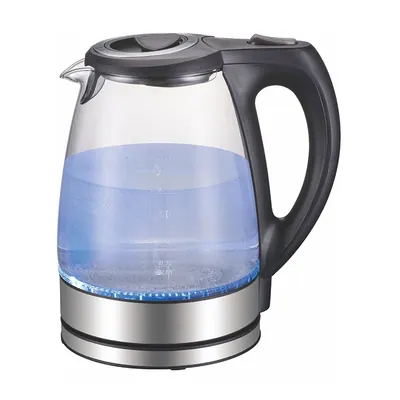
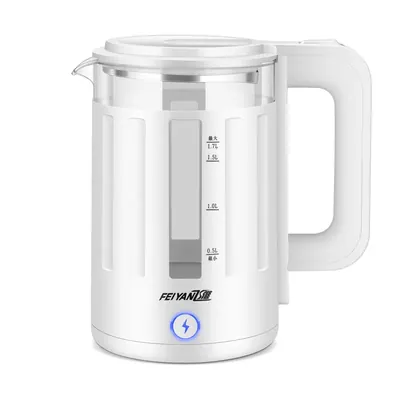
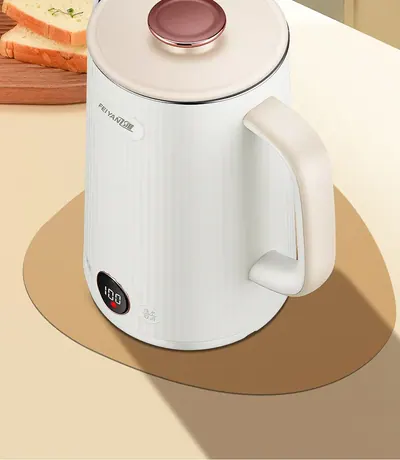
The boil-dry cut-out has two independent paths, and both are needed
A kettle switches off when steam reaches a sensor in the handle or the lid area. If the lid is open, or the kettle is switched on empty, no steam arrives — so a second, independent device is required: a thermal fuse or a bimetallic strip that opens on temperature.
Good designs have the steam switch as the normal control and the thermal cut-out as a one-time or resettable backstop. Cheap designs rely on one device, which is the failure mode that turns a kettle into a hazard. This is checked on samples against the applicable standard, and it is the first thing to inspect.
Cordless connector: the part that limits the current
The 360° cordless base uses a connector that carries the full element current. At 3000 W on 230 V that is 13 A, and the connector has to do it repeatedly without tracking or overheating. A poor connector heats up, discolours, and eventually fails.
The cost difference between a connector rated for the current and one that is marginal is small, and it is the difference between a kettle that lasts years and one that comes back. It is also why high-wattage kettles are usually not sold into 110 V markets: at 120 V the same power needs 25 A, which the connector and the cord cannot comfortably carry.
| Market | Typical voltage | Power for a fast boil | Current | What changes |
|---|---|---|---|---|
| UK / EU | 230 V | 2500–3000 W | 11–13 A | Standard — the fastest kettles in the world |
| North America | 120 V | 1500 W | 12.5 A | Slower boil; higher wattage is limited by the circuit |
| Japan | 100 V | 1200–1300 W | 12–13 A | Slowest boil; element re-rated |
| Australia | 230 V | 2200–2400 W | 10 A | Limited by the standard socket circuit |
Scale, the filter and the element
A concealed element is easier to clean and is the standard in most markets, but it is also closer to the water and scales faster. A removable limescale filter at the spout stops scale flakes ending up in the cup, which is the most common complaint in hard-water areas.
The shape of the interior matters: a flat base with a wide opening can be descaled by the customer with a cloth; a narrow neck with a hidden element cannot, and the kettle is discarded when it slows down.
Temperature control, and why tea markets ask for it
Green tea is damaged by boiling water, so markets that drink it want selectable temperatures — typically 70, 80, 90 and 100 °C. That requires a thermistor and a control board, and it is a different product from a switch kettle, not a feature.
The control also changes the safety review, because the kettle now has electronics that must fail safely. A firmware fault that keeps the element on with no water has to be caught by the thermal fuse, which is why the fuse is specified independently of the control.
Market configuration at a glance
| Market | Voltage | Plug | What changes |
|---|---|---|---|
| UK | 230 V | G (fused) | Highest power, fused plug mandatory, cordless base standard |
| EU | 220–240 V | C / F | Power capped by socket circuit in some countries |
| North America | 110–120 V | A / B | Lower power, longer boil, different connector rating |
| Japan | 100 V | A | Re-rated element, temperature-control models popular |
| Australia / NZ | 230–240 V | I | Insulated pins, 10 A circuit limit |
Electric kettle questions buyers ask
Why do kettles boil faster in the UK?
Because a 230 V circuit can deliver 3000 W from a standard socket, while a 120 V circuit is limited to about 1500 W for the same current. The kettle is not better; the supply allows more power.
What are the two cut-outs for?
The steam switch turns the kettle off when the water boils. The thermal cut-out protects against the case where no steam arrives — an open lid or an empty kettle. Both are required; relying on one is the failure mode that makes a kettle dangerous.
Why does my kettle take longer than it used to?
Scale on the element. A scaled element transfers heat through a mineral layer, so the water takes longer and the element runs hotter. A removable filter and an accessible base are what let the customer fix it.
Does a variable temperature kettle need different certification?
It needs the same safety review plus the electronics, and the control has to fail in a way the thermal fuse still catches. The fuse is specified independently of the control for exactly that reason.
Tell us the market and whether the kettle needs temperature selection, and we will specify the power, the connector rating and the two cut-outs as separate items.
Need help choosing?
Send us the product type, target market and estimated volume — we will shortlist models and quote.