Air Pump OEM & ODM
19 tire inflator and portable air pump models, in 12V corded and rechargeable formats with analogue and digital gauges. An inflator is bought for one reason — the gauge has to be right — and the specification that decides whether the customer trusts it is the accuracy of the reading, not the maximum pressure the pump can reach.
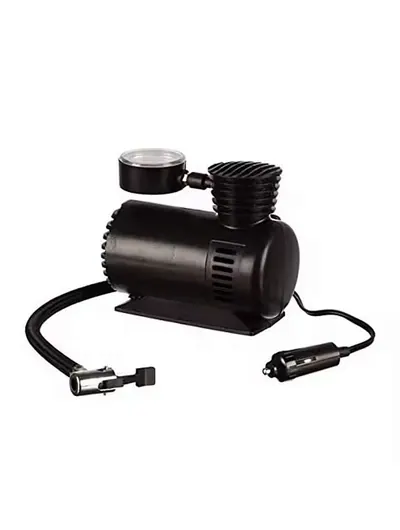
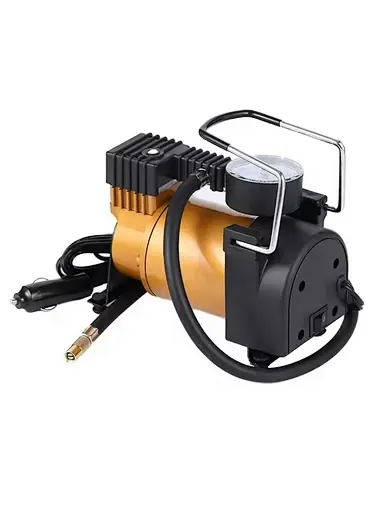
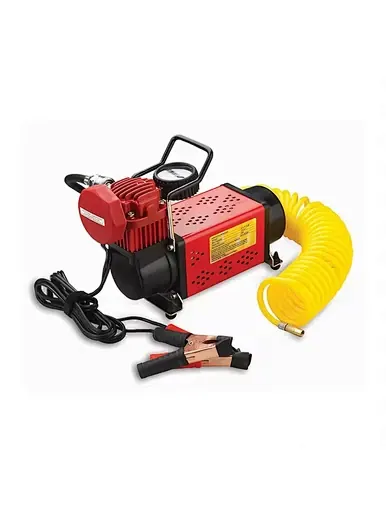
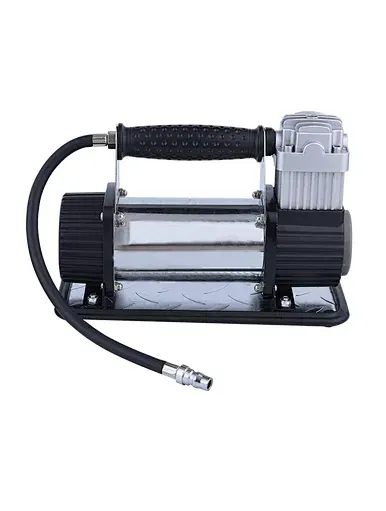
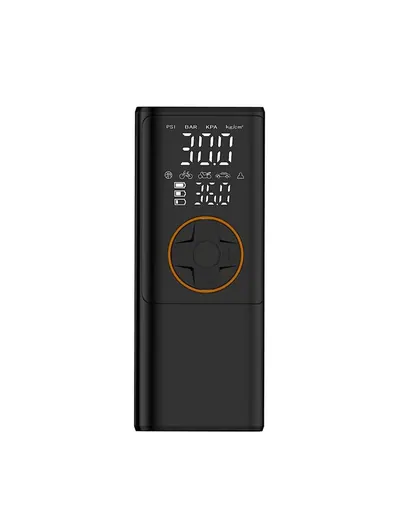
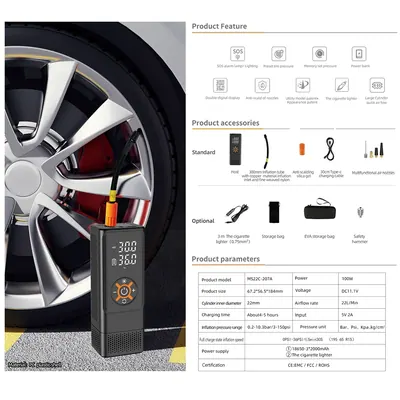
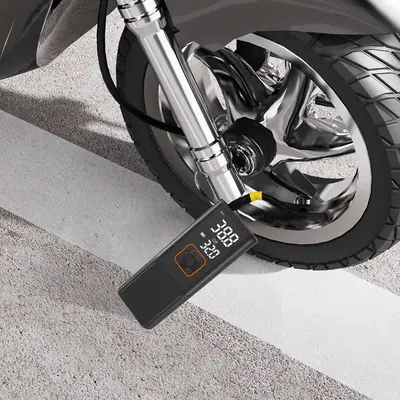
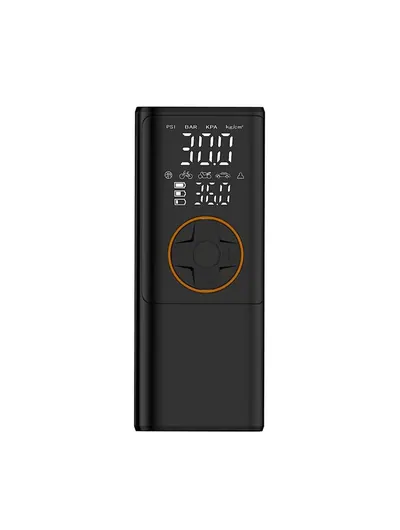
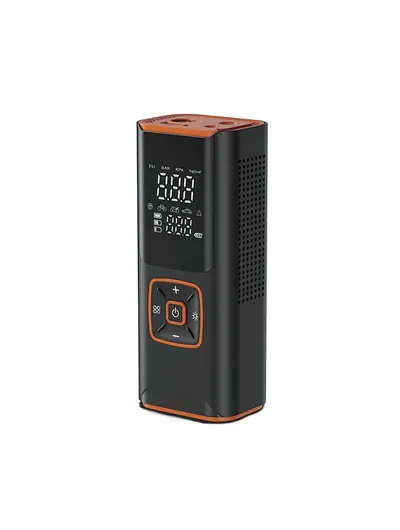
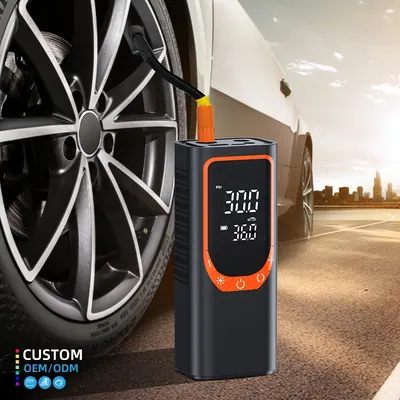
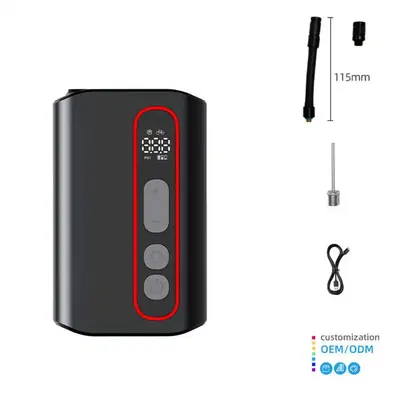

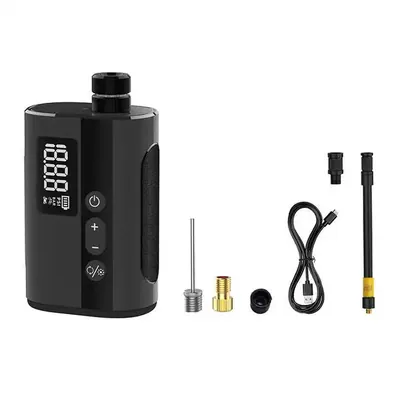
Gauge accuracy is the product
A tire inflator is used to set a pressure that matters: the vehicle's recommended figure, which the driver checks against. If the gauge reads two tenths of a bar high, the tires end up under-inflated; if it reads low, the driver over-inflates them and wears the center of the tread.
That makes gauge accuracy the primary specification, and it is not the number printed largest on the box. A pump rated to a high maximum pressure with an inaccurate gauge is less useful than a modest pump that reads correctly. The relevant comparison is accuracy across the range the customer will use, not the ceiling.
It is also worth being precise about the display. An analogue dial that can be read to a tenth of a bar is more useful in practice than a digital readout that resolves to a hundredth, because the driver is comparing to a figure in a manual and not to a laboratory value.
Pressure and volume are different jobs
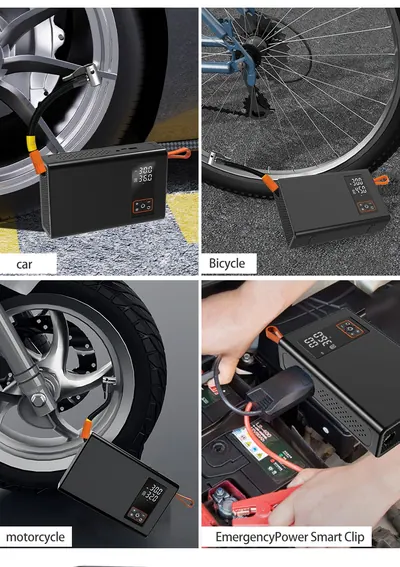
A car tire needs relatively high pressure and a modest volume of air. A bicycle tire needs higher pressure still. An airbed, a paddling pool and a beach ball need low pressure and a large volume. A pump that is good at one is frequently poor at the other, because the mechanism that produces high pressure and the one that moves a large volume cheaply are not the same.
This is why inflators are usually specified with a stated use and a set of adapters. A buyer selling into a general retail channel is usually better served by a pump that covers car and bicycle tires well than by one claiming to cover everything, because the customer who buys it for an airbed will be disappointed whichever unit is chosen.
Where a product genuinely has to cover both, the specification is a two-stage mechanism or a larger cylinder, and both cost more than a straightforward tire pump.
Specification decisions that move the unit cost
| Decision | What it changes | Why it moves the price |
|---|---|---|
| Power source | 12V corded from the car socket, or a rechargeable battery | A battery adds cells, a charging circuit and shipping documentation, and removes the need to reach the socket |
| Pump mechanism | Diaphragm or piston, and the cylinder size | A piston pump reaches higher pressure and vibrates more; a larger cylinder moves more volume at lower pressure |
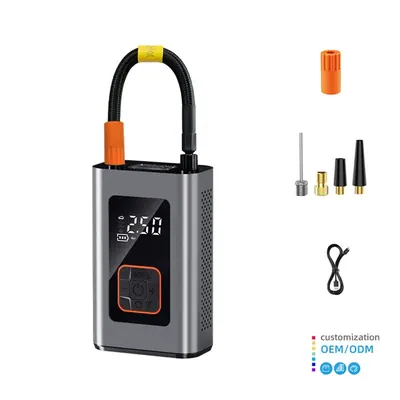
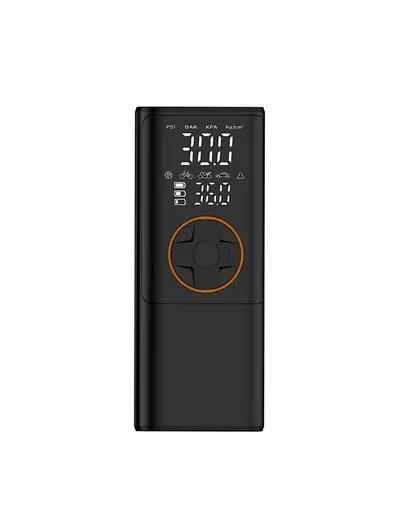
| Gauge | Analogue dial, digital with a preset, or none | A digital gauge with auto-stop adds a sensor, a display and firmware, and it is frequently the feature buyers compare on |
| Auto-stop accuracy | How close to the set pressure the pump actually stops | Being able to set a pressure is only useful if the pump stops at it, and the tolerance is a calibration decision rather than a component one |
| Hose and coupling | Length, material and the type of valve connection | A screw-on connector is slower to use and does not leak; a clip-on is faster and is the more common source of complaints |
| Housing and storage | Whether the hose and cable stow, and the shape of the case | Car accessories are stored in boots and dropped; a housing that cracks or a cable that will not stow becomes the reason for a negative review |
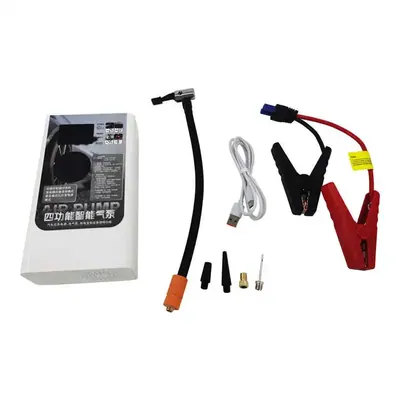
| Light and extras | Work light, carry bag, adapter set | The LED and the bag are cheap individually and are what the buyer sees when the box is opened |
The valve connection is where the complaints are
The coupling that attaches the pump to the valve is the part of the product the customer handles most and the part most likely to generate a complaint. A clip-on connector that leaks, or that has to be held in place while the pump runs, defeats the purpose of an inflator.
A screw-on connector seals reliably but takes time and is awkward on a second valve. A lever clip-on is faster and has to be designed so that it seats positively and stays seated under the pump's vibration. That is a moulding and tolerance decision rather than a component choice, and it is worth confirming on a sample under pressure rather than by hand.
The hose length matters alongside it. A hose that is too short forces the customer to hold the pump in the air while it runs, which is the situation the product exists to avoid.
Voltage, plug type and compliance by market
We do not pre-certify every SKU. Testing and certification are arranged for the specific model and the specific market you are ordering for, and quoted as their own line. For rechargeable models the battery documentation is part of that; for 12V models the plug and lead are assessed as supplied.
| Market | Power | What is usually required |
|---|---|---|
| European Union | 12V socket, or 220–240V for the charger | CE marking with test reports behind it, plus battery documentation where a cell is supplied |
| United Kingdom | 12V socket, or 230V for the charger | UKCA marking with the test reports and the same battery documentation |
| North America | 12V socket, or 110–120V for the charger | Listings that automotive and general retailers accept before the product can be sold |
| Australia and New Zealand | 12V socket, or 230–240V for the charger | Electrical safety approval, with the charger assessed separately where one is supplied |
| Middle East and Southeast Asia | 12V socket, or 220–240V for the charger | Depends on the destination; conformity documents are frequently required at customs |
Branding, packaging and the impulse shelf
Inflators sell from a pegboard or a shelf next to other car accessories, frequently without assistance, which makes the box front the selling surface. Stating the gauge accuracy and the intended uses on the front does more than a large pressure figure, because it tells the customer whether the product is the right one.
On the product, pad printing and silk screen suit plastic housings. Where the pump is stored in a car, a moulded case with the cable and hose stowed is part of the product and is frequently what the buyer approves first.
Packaging should be sized for the retailer's planogram where one exists. Send it at brief stage rather than after the first delivery, because a box that does not fit the peg is a box the retailer will not list.
Air pump questions buyers ask
How accurate should the gauge be?
Accurate enough that the driver can trust it against the vehicle's recommended figure, which is the specification worth quoting rather than the maximum pressure. It is worth confirming on a sample against a known reference rather than relying on the stated figure.
Can one pump cover car tires, bicycles and airbeds?
Not well. Car and bicycle tires need higher pressure with modest volume; airbeds and pools need low pressure with large volume. A pump specified for tires and supplied with adapters covers the common cases; a product claiming to cover everything usually disappoints on one of them.
12V corded or rechargeable?
Corded is cheaper, lighter and has no battery to fail or to document. Rechargeable is convenient and does not depend on reaching the car socket, at the cost of cell, charger and shipping documentation. Many buyers run both as an entry and an upgrade.
Why do customers complain about the connector?
Because a clip-on coupling that leaks or has to be held while the pump runs defeats the purpose. A lever clip-on has to seat positively under vibration, which is a tolerance decision worth checking on a pressurised sample.
What is the minimum order for an air pump?
It is quoted per model, because it depends on the model and on how much of it is already tooled. Both the minimum order quantity and the lead time are stated on the quotation for the specific model you pick.
Do the pumps come with certification?
We do not claim blanket certification across the catalog. Certification and battery documentation are arranged for the specific model and the specific market you are ordering for, and quoted as their own line.
If the pump you need is not in this list, send the specification — power source, pressure class, gauge type and intended uses — and we will tell you what is available.
Need help choosing?
Send us the product type, target market and estimated volume — we will shortlist models and quote.